Booking now open for summer!
How long meals, shared plates and pacing define the Spanish way of eating
In many parts of the world, dining has become transactional. Food arrives fast, plates are individual, and the goal is efficiency.
Spanish dining operates on a completely different logic.
In Spain, eating is not an interruption of the day. It is the day.
Meals are designed to unfold slowly, allowing flavors, conversations and moments to develop naturally. Understanding Spanish cuisine requires understanding its relationship with time.
Spanish cooking is not rushed, and neither is the way it is eaten.
Dishes like paella, slow-simmered broths, grilled seafood and tapas are meant to arrive in stages. This pacing is intentional. It allows diners to engage with each plate instead of consuming everything at once.
Time is not inefficiency.
Time is structure.
Spanish dining follows a rhythm rather than a fixed sequence.
Small plates arrive first. Then something warm. Then something shared. Then something lingering. The table evolves throughout the meal, encouraging interaction rather than isolation.
This structure creates:
The meal is not something to finish. It is something to inhabit.
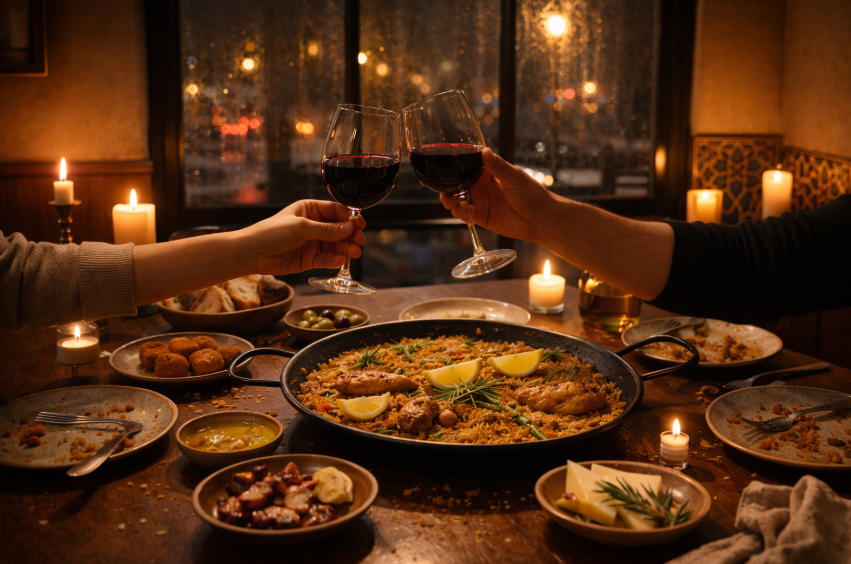
Spanish cuisine is designed for the center of the table.
Tapas, paellas and shared seafood dishes reinforce the idea that food is a collective experience. Individual plating is secondary. What matters is what happens between the plates.
Sharing changes behavior.
People slow down. They talk. They taste. They negotiate what comes next.
This is not accidental. It is cultural design.
Fast dining prioritizes convenience but often sacrifices memory.
Meals become interchangeable. Dishes blur together.
Spanish dining resists that model. By slowing the pace, it creates:
People may forget what they ate quickly.
They rarely forget how a Spanish meal made them feel.
At Puerta del Sol, the menu is built to be explored gradually.
Tapas invite the table to begin without pressure. Paellas arrive when the moment is right, not immediately. Desserts are an extension of the conversation, not a signal that the meal is ending.
Nothing is rushed.
Nothing is accidental.
The experience mirrors Spain’s approach to dining: deliberate, social and grounded in time.
In a fast-paced region like the Bay Area, Spanish dining offers contrast.
It invites people to pause.
To disconnect from urgency.
To replace efficiency with intention.
This is why Spanish restaurants are becoming destinations rather than stops. They offer something increasingly rare: permission to slow down without guilt.
Spanish dining is not about how fast food arrives.
It is about how long the experience stays with you.
When time is treated as an ingredient, meals become meaningful.
And that is what defines the Spanish way of eating.
Why do Spanish meals take longer?
Because Spanish dining prioritizes social interaction, pacing and shared experiences over speed.
Is Spanish food meant to be shared?
Yes. Many Spanish dishes are designed for the center of the table to encourage conversation and connection.
Why are tapas served before main dishes?
Tapas ease diners into the meal, allowing flavors and conversation to develop gradually.
Is slow dining common in Spain?
Very. Meals are considered an important part of daily life, not something to rush through.
Why does Spanish dining feel more relaxed?
Because it removes pressure to finish quickly and focuses on presence rather than productivity.
.png)
.jpg)
.jpg)
.jpg)
.jpg)
.jpg)