¡La reserva ya está abierta para el verano!
The social meaning behind Spain’s most famous recipe—and why it was designed to be shared.
Outside Spain, paella is often treated like an individual entrée.
One plate. One person. One portion.
In Spain, that approach misses the point entirely.
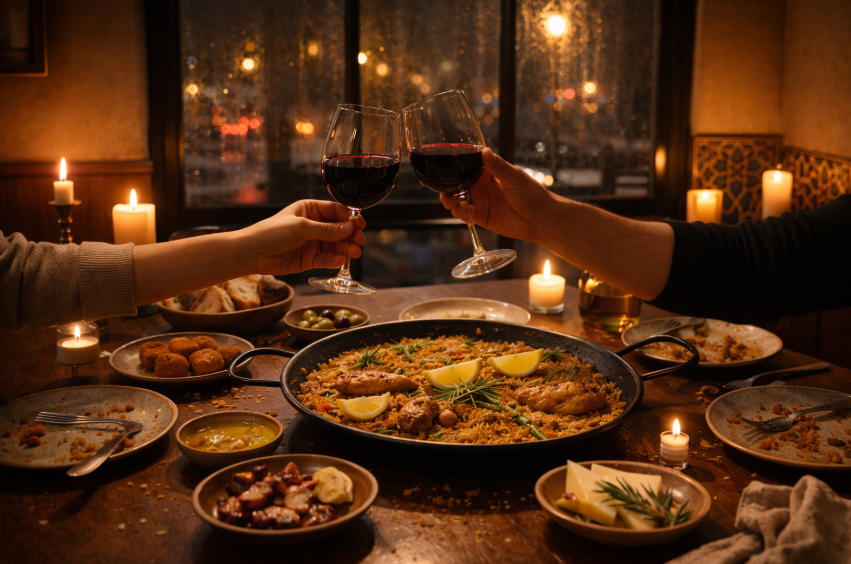
Paella was never meant to be eaten alone. It was created as a communal dish, cooked in a wide pan and placed at the center of the table. Its purpose goes beyond nourishment—it structures how people gather, talk and spend time together.
The traditional paella pan is wide and shallow for a reason.
It allows the rice to cook evenly, develop socarrat, and be shared without hierarchy. There is no “best portion.” Everyone eats from the same surface.
This design removes individual ownership of the dish and replaces it with a collective experience. The meal becomes shared territory.
When paella is shared, time behaves differently.
People wait for the pan to arrive.
They serve each other.
They pause between bites.
The meal slows naturally, not by instruction but by structure. Paella introduces patience into dining—and with it, conversation.
In Spanish culture, ordering paella is a decision made together.
It requires agreement, coordination and a willingness to share.
This simple act shifts the dynamic at the table:
Paella is not flexible food. It asks diners to align.
When paella is divided into individual plates, something essential is lost.
The heat fades faster.
The socarrat disappears.
The sense of ritual weakens.
More importantly, the shared moment dissolves. The dish becomes just another item, disconnected from its cultural role.
At Puerta del Sol, paella is served the way it was intended.
Prepared for the table.
Presented at the center.
Meant to be shared.
The timing, portioning and presentation are all designed to protect the social rhythm of the dish. Paella arrives when the table is ready—not rushed, not fragmented.
In a culture dominated by speed and personalization, paella offers resistance.
It asks people to slow down.
To share control.
To experience food together.
That is why paella feels memorable. Not because of complexity, but because of connection.
Paella is not efficient food.
It is intentional food.
When shared properly, it becomes more than a meal—it becomes the moment people remember. And that is why paella, at its core, will always belong at the center of the table.
Why is paella meant to be shared?
Because it was designed as a communal dish that structures social interaction and pacing.
Can paella be eaten individually?
It can, but doing so removes much of its cultural and experiential value.
Why is paella cooked in a wide pan?
To allow even cooking, socarrat formation and easy sharing.
Is sharing paella traditional in Spain?
Yes. Paella is traditionally ordered for the table and eaten together.
Does sharing affect the flavor?
Yes. Shared paella retains heat, texture and balance better than plated portions.
.png)
.jpg)
.jpg)
.jpg)
.jpg)
.jpg)