¡La reserva ya está abierta para el verano!
The cultural difference most American menus get wrong—and why it matters.
On many menus, tapas are translated as appetizers.
The comparison feels convenient—but it’s inaccurate.
While both appear at the beginning of a meal, tapas and appetizers are built on entirely different ideas. One prepares you to eat. The other is the way you eat.
Understanding this difference changes how Spanish food should be experienced.
Appetizers serve a functional role in American dining.
They arrive first.
They stimulate appetite.
They disappear once the main dish arrives.
Their purpose is transitional. They are not meant to stand alone or shape the rhythm of the meal. Once the entrée arrives, appetizers become irrelevant.
Efficiency defines the structure.
Tapas are not a course.
They are a system.
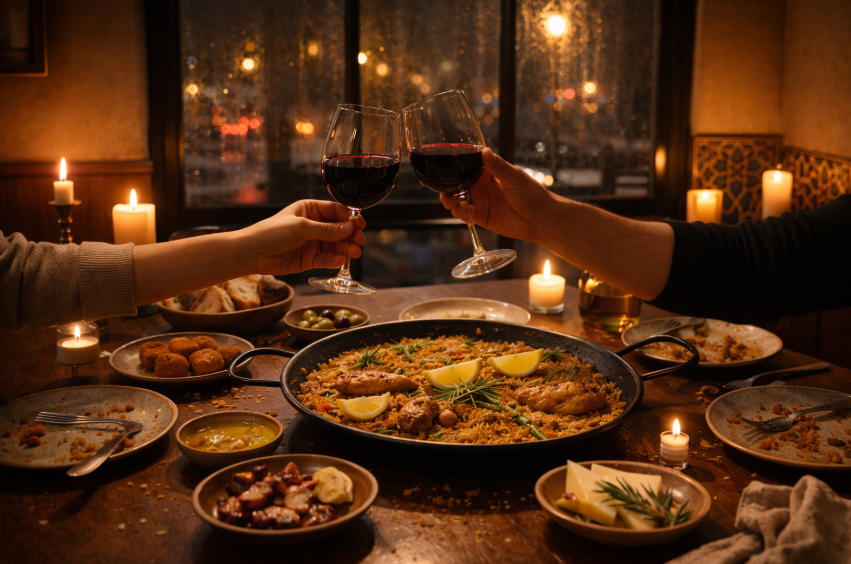
In Spain, tapas are meant to circulate through the table—arriving gradually, overlapping, inviting discussion. There is no clear beginning or end. The meal evolves as new plates appear.
Tapas are about:
The focus is not what comes next, but what is happening now.
Appetizers follow a schedule.
Tapas follow a rhythm.
Tapas may arrive before, during or instead of a main dish. They respond to the table, not the clock. This flexibility allows meals to stretch naturally, adjusting to the energy of the group.
There is no pressure to move on.
Tapas are often described as “small plates,” but size is secondary.
What defines a tapa is intention. A tapa is complete on its own. It does not exist to support another dish. It exists to be shared, discussed and enjoyed at its own pace.
Appetizers, by contrast, are incomplete by design.
Tapas remove the boundary between plates.
Instead of each diner focusing on their own order, the table becomes the focal point. Decisions are made collectively. Flavors are compared. Preferences are negotiated.
This structure encourages:
Tapas don’t just feed people. They connect them.
At Puerta del Sol, tapas are not an opening act.
They are the core of the experience.
The menu is designed so that guests can:
There is no fixed sequence—only intention.
Calling tapas “appetizers” simplifies them out of existence.
It removes their cultural meaning and turns a social tradition into a logistical step. When tapas are understood properly, dining shifts from fast to immersive.
That shift is what Spanish cuisine offers—and what makes it resonate so strongly in California today.
Are tapas the same as appetizers?
No. Appetizers prepare you for a meal. Tapas are the meal.
Can tapas replace a full dinner?
Yes. Multiple tapas shared at the table create a complete dining experience.
Why are tapas served gradually?
To allow conversation, pacing and shared decision-making throughout the meal.
Are tapas meant to be shared?
Always. Sharing is central to tapas culture.
Why do Spanish restaurants emphasize tapas?
Because tapas reflect how food is traditionally enjoyed in Spain—socially and without haste.
.png)
.jpg)
.jpg)
.jpg)
.jpg)
.jpg)